
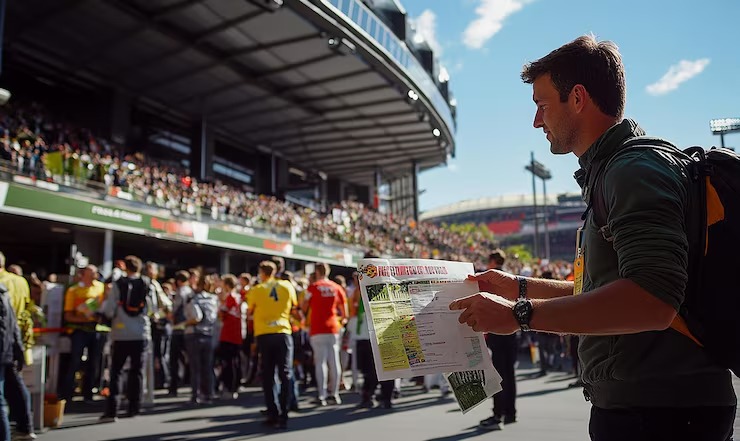
Sports fans are the most loyal, emotionally attached audiences on the planet. They dress in their team colors, travel across the country to playoff games and define parts of their personal identity by the teams they root for. In-stadium activations provide a unique opportunity for brands to engage meaningfully with this audience in a way no other marketing channel can deliver.
The Unique Power of the Stadium Moment
A stadium on game day is one of the most concentrated pools of engaged audience attention that exists in the real world. Unlike digital platforms, where audiences are fragmented and distracted, a stadium brings thousands of people together with a shared purpose and a shared emotional investment. That shared energy creates a context in which brand experiences land harder, linger longer, and get talked about more than the same experience would in any other setting.
Why Traditional Advertising Falls Short in Stadiums
Banner ads and scoreboard graphics have been part of stadium marketing for decades. While they serve a purpose, they have become so familiar that most fans’ eyes move past them without conscious recognition. The brands that break through this attention deficit are the ones that create something physically present, dimensionally interesting, and genuinely interactive. That is the fundamental value proposition of in-stadium activations built around custom fabricated installations.
Turning Halftime Into a Brand Moment
Halftime is one of the most valuable windows in stadium marketing. Fans are out of their seats, moving through the concourse, and looking for something to engage with while they wait for the second half. A well-placed brand activation zone in a high-traffic concourse area captures this audience at exactly the right moment, offering them an experience that connects the brand to the game-day energy they are already feeling.
Designing Activations That Fit the Fan Experience
The most effective stadium activation design does not feel like advertising. It feels like an enhancement of the fan experience, an addition to the fun that happens to carry a brand’s visual identity. This requires a deep understanding of what fans are there for, what they respond to emotionally, and how the activation can contribute something genuinely valuable to their game-day experience rather than simply competing for their attention.
Installations That Are Fan-Centric
Fan-first design begins with empathy. What do fans really want to interact with? What would they be proud to fire and show off? What would they say to their friends after the game?Interactive games, immersive sculptures, oversized props tied to team history for photo ops, and branded zones that celebrate fan culture all answer these questions in ways that generic sponsor signage simply can’t.
The Social Media Amplification Effect
One of the most powerful aspects of a well-designed stadium activation design is its ability to generate social content that extends the brand’s reach far beyond the stadium walls. When fans photograph themselves at a striking activation and share that content on their social channels, every follower they have becomes an indirect impression for the brand. At scale, across thousands of fans over a full season, this organic social amplification delivers a reach that paid media would struggle to match.
What Great Fabrication Delivers in Stadium Contexts
Building for a stadium environment demands more than creative design talent. It requires engineering precision, durable materials, and construction methods that hold up under the physical demands of high-traffic public spaces. High-density foam with proper hardcoating delivers visual quality indistinguishable from other materials while being lightweight enough for the complex installation logistics that stadium environments demand.
Artists and Engineers Working Together
The best in-stadium builds happen when artistic vision and structural engineering work in tandem from the beginning. Artists bring the visual storytelling that makes an installation compelling. Engineers make sure the structure is safe and stable and will stand up to the demands of the environment. When these disciplines collaborate from the first sketch, the result is a piece that is both beautiful and practical, which is exactly what a stadium environment requires.
Summary
When done right, in-stadium activations are one of the most powerful weapons in a brand’s marketing arsenal. It’s the combination of passionate audiences and shared emotional energy and the right physical experience that makes moments people actually remember and share. Done right, a stadium activation can build brand affinity that lasts far beyond the final game of the season.
FAQ
Q1: How do in-stadium activations differ from regular event sponsorships?
Traditional sponsorships are largely passive, displaying brand logos on signage. In-stadium activations are interactive experiences that fans seek out and engage with, creating stronger and more memorable brand connections.
Q2: Where are the best locations to place an activation within a stadium?
High-traffic concourse areas near entrances and food concessions, as well as gathering zones near gates, are ideal locations for capturing fan attention during pre-game and halftime.
Q3: How long does it take to design and build a stadium-ready installation?
Most stadium activation builds take four to eight weeks from concept approval to installation, though timelines vary based on scale and complexity.